Myths About Immigration Law
Is Crossing the Border Illegally a Crime?
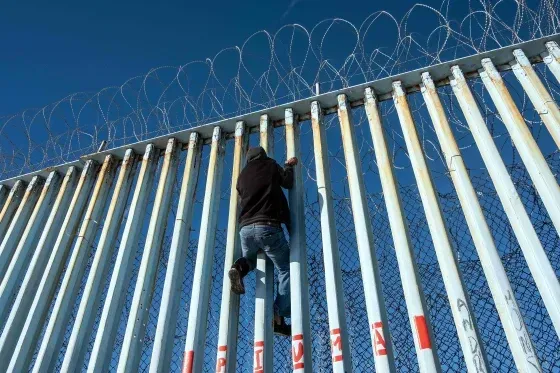
Recently, one of the most common arguments between politicians related to illegal immigration has to do with whether or not crossing the border illegally is purely an administrative law violation or a criminal law violation. Immigration law in general can be very confusing to understand for people who do not deal with it on a daily basis and even most lawyers have little accurate insight as to its proper application. This confusion is only compounded by politicians who speak about it dishonestly, either out of ignorance or a desire to cater to their political base. It is tragic that all of our political parties are unwilling to have an open and honest discussion about the truth behind immigration law. Realistically, it takes longer than a short sound bite on your average news channel to fully explain and intelligently comprehend.
Confusingly, Illegal Immigration is both a Federal Criminal Violation AND a Federal Administrative Violation. It all depends on the how, why and where the violation is leveraged. As it stands in 2026, Immigration law is based on the Immigration and Nationality Act (INA) of 1952 and is codified in Title 8 of the United States Code.
Title 18 (Crimes and Criminal Procedure) of the United States Code(USC) is the primary section of US code that deals with majority (but not all) of federal criminal violations. One commonly propagated misbelief is that since Immigration Laws are not part of Title 18 USC, it is not a crime. This is a grossly inaccurate interpretation of immigration statutes. There are many other sections of US Federal Codes such as Title 9 USC (Customs Law) or Title 21 USC (Narcotics Laws) that deal with other crimes and penalties. Many of these laws, like Tax Law (Title 26), have both administrative and criminal penalties. Immigration law is similar in design and application.
Immigration law under Title 8 of the US Code has both administrative provisions and criminal penalties, in some cases for the same violation. Illegally crossing the border is one of those crimes that has both administrative and criminal penalties that are potentially applicable. A simple review of the statute in question will help confirm this interpretation.
- 8 U.S. Code § 1325 - "Improper Entry by Alien"
- (a) Improper time or place; avoidance of examination or inspection; misrepresentation and concealment of facts Any alien who (1) enters or attempts to enter the United States at any time or place other than as designated by immigration officers, or (2) eludes examination or inspection by immigration officers, or (3) attempts to enter or obtains entry to the United States by a willfully false or misleading representation or the willful concealment of a material fact, shall, for the first commission of any such offense, be fined under title 18 or imprisoned not more than 6 months, or both, and, for a subsequent commission of any such offense, be fined under title 18, or imprisoned not more than 2 years, or both.
- (b) Improper time or place; civil penalties Any alien who is apprehended while entering (or attempting to enter) the United States at a time or place other than as designated by immigration officers shall be subject to a civil penalty of—(1)at least $50 and not more than $250 for each such entry (or attempted entry); or (2)twice the amount specified in paragraph (1) in the case of an alien who has been previously subject to a civil penalty under this subsection. Civil penalties under this subsection are in addition to, and not in lieu of, any criminal or other civil penalties that may be imposed.
The above cited Title 8 statute clearly outlines both criminal and civil penalties for this violation. The easiest way to determine if their is an applicable criminal penalty for a crime is by checking to see if a custodial sentence is one of the potentially applicable penalties. Here we can see that "not more than 6 months imprisonment" is an available criminal penalty for a first time offender, which quickly helps confirm that this is a criminal violation with a sentence that can result in a federal prison sentence.
Another myth often perpetuated by the media is that Misdemeanors are somehow not actual "crimes," which is obviously absurd at face value. Misdemeanor and Felony law violations are generally differentiated on the amount of potentially applicable jail or prison sentence, however, they are both crimes. There are all sorts of misdemeanor crimes both at the federal and State/Local level such as Misdemeanor Assault or Theft. Generally speaking, misdemeanors are crimes with jail sentences that do not exceed one year and felonies are crimes with maximum prison sentences of one year or higher.
The section of US Code that deals with the sentencing distiniction between Misdemeanors and Felonies is found in 18 U.S. Code § 3559 - Sentencing classification of offenses:
(a) Classification.—An offense that is not specifically classified by a letter grade in the section defining it, is classified if the maximum term of imprisonment authorized is—(1)life imprisonment, or if the maximum penalty is death, as a Class A felony;
(2) twenty-five years or more, as a Class B felony;
(3) less than twenty-five years but ten or more years, as a Class C felony;
(4) less than ten years but five or more years, as a Class D felony;
(5) less than five years but more than one year, as a Class E felony;
(6) one year or less but more than six months, as a Class A misdemeanor;
(7) six months or less but more than thirty days, as a Class B misdemeanor;
(8) thirty days or less but more than five days, as a Class C misdemeanor; or
(9) five days or less, or if no imprisonment is authorized, as an infraction.
At this point is is reasonable to ask oneself that if the US Code is this clear on these definitions, then why does it seem to be such a confusing issue among politicians and the media? Relatedly, why do many members of the public inaccurately believe immigration violations classified as misdemeanors are not a crime? Although both members of the media and our political establishment are keen to confuse the issue to suit their own purposes; I believe the primary reason has to do with the historical enforcement of immigration related crimes in the United States.
The Department of Justice (DOJ) Offices of the United States Attorneys prosecute federal crimes in federal criminal court and are the federal government's equivalent of "District Attorneys," as commonly understood by the public. Generally speaking most federal prosecutors seek to prosecute cases that carry significant prison sentences due to the cost and resources involved with federal criminal investigations and prosecutions. Additionally, due to the relatively small number of federal prosecutors, many cases are often selectively prosecuted for maximum impact (i.e. major human trafficker, large scale fraud, narcotics kingpin). Consequently, most federal prosecutors do not want to deal with minor federal violations that result in relatively short custodial sentences. Why make a "federal case" out of it and waist their time prosecuting something that only results in a six month federal prison sentence or a fine?
In the past most immigration violations exposed to relatively lower sentences were dealt with administratively, either in the field (where the law allowed for some nationalities to be immediately removed upon apprehension) or in Immigration Courts (where the primary purpose is to give due process as a part of the "Deportation" proceeding). As a part of this bifurcation, federal prosecutions were limited to more serious or repeat offenders (i.e., human smugglers, deported felons attempting to illegally re-enter).
The 2017 Trump Administration was one of the first administrations to make a major policy change regarding how immigration crimes were charged (criminally rather than administratively); mostly due to the rampant and obvious levels of fraud in the asylum process that problematically resulted in the release of most illegally present migrants by Immigration Courts. This policy change also resulted in widespread public discourse about family separations that previously was not a concern. Family separations were one of the downstream impacts of an administration suddenly charging immigration violators criminally and imposing mostly misdemeanor prison sentences before deporting them to their countries of origin. Like any other crime (i.e. state violation), when you go to jail or prison, family members do not share the jail cell, hence the family separation issue emerged.
In reality, the Executive Branch of the government retains broad discretion to dictate internal policy as it relates to the criminal law priorities, organizational focus and prosecutorial efforts. The Executive Branch cannot ignore the statutes passed by Congress but it has the discretion to choose how and where to focus its resources. Consequently, when a statute has both an administrative and criminal penalty, an the Executive Branch can clearly chose how to enforce. This is why there has been such a dramatic shift in immigration policy between different political administrations. Overnight a new administration can dictate a different manner of enforcing the law with stark and immediate results. This obviously occurred during Trump's second term when border apprehensions plummeted from a high of 2.7 million over a year to an astonishing low of 238,000.
Despite the obvious evidence to the contrary, many US politicians publicly insist that nothing can be done to address large swaths of illegal immigration until Congress acts and passes new laws. The reality is that Congress has already passed many immigration laws and given the Executive Branch a great deal of discretion in how it can enforce penalties to deal with emerging circumstances. The Trump Administration was simply one of the first to make such a dramatic shift in how immigration laws were enforced, which invariably caused confusion for the American public based on their historical observations.
The application of immigration law is a very simple issue. Anyone with an elementary level of education can read the above cited text and comprehend some of the basic provisions. Regardless of one's political beliefs there should not be any confusion. It is in fact a federal crime to cross the border illegally and that criminal statute does in fact come with both administrative and criminal penalties.